Every dissertation has a methodology chapter. Not every dissertation has a methodology that actually fits its research question.
That mismatch — between what a student wants to find out and how they've chosen to find it out — is one of the most common reasons dissertations get returned with major revisions. The research is sound. The writing is competent. But the method doesn't answer the question.
This guide walks through the main research methodologies, what each one is actually good at, and how to tell which one fits your research question.
The three broad approaches
Almost every research methodology fits under one of three umbrellas.
Quantitative — you measure things, work with numbers, and look for statistical patterns.
Qualitative — you explore meaning, work with words, and look for rich description and interpretation.
Mixed methods — you combine both, usually because one approach alone can't answer your research question completely.
Everything else — experimental design, case study, ethnography, grounded theory — is a specific method that sits inside one of these three. So the first decision is always: which of these three is my project?
Quantitative research
Quantitative research answers questions that can be expressed as numbers. How many, how often, how much, to what extent, does X affect Y.
What it's good at:
- Measuring relationships between variables
- Testing hypotheses against data
- Generalizing findings from a sample to a population
- Producing results that can be compared across studies
What it's not good at:
- Explaining why something happens
- Capturing nuance, context, or lived experience
- Exploring questions where variables aren't yet known
Typical methods:
- Surveys with closed-ended questions
- Experiments and quasi-experiments
- Secondary data analysis (using existing datasets)
- Statistical modelling (regression, structural equation modelling, etc.)
Typical research questions:
- "Is there a relationship between X and Y?"
- "Does intervention A produce better outcomes than intervention B?"
- "What proportion of the population experiences Z?"
What a good quantitative methodology chapter does:
It justifies why this is a quantitative project — why the question requires measurement, why the chosen variables are the right ones, and why the statistical approach fits the data. It also addresses validity and reliability explicitly.
Qualitative research
Qualitative research answers questions about meaning, experience, and process. How do people understand X? What does it feel like to experience Y? What happens when Z unfolds over time?
What it's good at:
- Understanding how people make sense of their world
- Exploring phenomena that aren't well understood yet
- Capturing complexity and context
- Generating theory rather than testing it
What it's not good at:
- Producing findings that generalize to a population
- Testing hypotheses numerically
- Measuring the strength of relationships
Typical methods:
- Semi-structured or unstructured interviews
- Focus groups
- Participant observation and ethnography
- Document analysis
- Case study research
- Grounded theory
- Phenomenology
- Narrative inquiry
Typical research questions:
- "How do people experience X?"
- "What does Y mean to those who live it?"
- "How is Z enacted in practice?"
- "What happens when..."
What a good qualitative methodology chapter does:
It justifies why the question requires depth rather than breadth. It explains the researcher's philosophical position (interpretivist, constructivist, etc.), how participants were selected, how data was analysed (thematic analysis, IPA, discourse analysis), and how the findings' trustworthiness was established (credibility, transferability, dependability, confirmability).
Mixed methods research
Mixed methods research combines quantitative and qualitative approaches, usually because the research question has multiple parts that no single method can answer.
What it's good at:
- Answering multi-part research questions
- Triangulating findings from different sources
- Explaining quantitative results with qualitative depth (or vice versa)
- Producing richer, more credible conclusions
What it's not good at:
- Being quick. Mixed methods takes longer than either approach alone.
- Being simple. You need to justify not one but two methodological choices.
Typical designs:
- Explanatory sequential — quantitative first, then qualitative to explain the numbers
- Exploratory sequential — qualitative first, then quantitative to test what emerged
- Convergent parallel — both at the same time, then integrated
- Embedded — one approach dominates, the other is a supporting component
Typical research questions:
- "To what extent does X happen, and how do participants experience it?"
- "What predicts Y, and why?"
- "Does intervention A work, and if so, how?"
What a good mixed methods methodology chapter does:
It justifies why one method alone wouldn't have answered the question, explains the specific design (sequential, parallel, embedded), and — critically — shows how the two strands were integrated. Integration is the part most students get wrong. Mixed methods isn't two separate studies stapled together; it's an integrated design where each strand informs the other.
The specific methods (and what they're for)
Inside those three broad approaches, you'll encounter specific named methodologies. Here's a quick guide to what each is and when it's appropriate.
Case study research
What it is: In-depth analysis of one or a small number of bounded cases — an organization, a person, an event, a policy.
When to use it: When you want to understand a phenomenon in its real-world context and the boundaries between the phenomenon and context are unclear.
Watch out for: Justifying why this case. A case study isn't just a small study — it's a study of something that's bounded and can be intensively examined.
Ethnography
What it is: Immersion in a cultural group or setting to understand it from the inside.
When to use it: When you want to understand the practices, meanings, and worldviews of a specific community.
Watch out for: The time it takes. Ethnography is a slow method, and most postgraduate projects don't have the timeframe to do it properly.
Grounded theory
What it is: Building theory from data, using iterative cycles of collection, coding, and comparison.
When to use it: When existing theory doesn't explain a phenomenon well, and you want to generate new theory from the field.
Watch out for: Confusion between grounded theory as a method and "thematic analysis" — they're not the same thing. Grounded theory has specific commitments (constant comparison, theoretical sampling, saturation).
Phenomenology
What it is: Studying how people experience a specific phenomenon, focusing on the essence of that experience.
When to use it: When your research question is genuinely about lived experience — not opinions, not beliefs, but what it is like.
Watch out for: Sliding into generic qualitative research. Phenomenology has its own philosophical commitments and analytical procedures (IPA, descriptive phenomenology).
Experimental design
What it is: Manipulating a variable and observing its effect while controlling for others.
When to use it: When you want to establish causality, not just correlation.
Watch out for: Feasibility. True experiments are rarely possible outside a lab, and quasi-experiments (which lack random assignment) are weaker for causal claims.
Action research
What it is: Research conducted by practitioners about their own practice, with a cyclical cycle of plan, act, observe, reflect.
When to use it: When you're researching something you're actively involved in — a classroom, a workplace, a community programme.
Watch out for: Objectivity concerns. Action research is inherently insider research, and the methodology chapter needs to address this directly.
Systematic review / meta-analysis
What it is: Structured synthesis of existing research on a specific question.
When to use it: When you want to summarise what's known about a topic using rigorous, reproducible methods.
Watch out for: Not confusing it with a narrative literature review. Systematic reviews follow a strict protocol (PRISMA), with inclusion criteria, search strategy, and quality assessment.
How to choose
Three questions. Answer them and the methodology almost picks itself.
Question 1 — What kind of answer does your research question need?
If the answer is a number ("how many," "to what extent," "is there a relationship"), you're doing quantitative.
If the answer is descriptive or interpretive ("how do people experience this," "what does this mean"), you're doing qualitative.
If the answer is both — a quantity and a meaning — you might be doing mixed methods.
Question 2 — What's the current state of knowledge on your topic?
If there's a lot of existing theory and you're testing it, quantitative fits.
If the topic is under-researched and you're exploring it, qualitative fits.
If research exists but the picture is fragmented, mixed methods can be useful for connecting different strands.
Question 3 — What can you actually do?
Feasibility matters as much as theory.
- Do you have time? Ethnography takes months. Surveys can be done in weeks.
- Do you have access? Interviewing senior executives requires more gatekeeping than surveying your peers.
- Do you have the skills? Advanced statistical analysis has a steep learning curve.
- Do you have the budget? Some methods (lab experiments, travel for fieldwork) cost real money.
A perfect methodology that you can't execute is worse than an imperfect one you can.
The mistake most students make
They pick a method because it's familiar, or because a supervisor used it, or because it seems less intimidating. Then they write a research question that fits the method — rather than picking a method that fits the question.
This is backwards. The research question comes first. Everything else follows.
If you're stuck on the methodology, the honest first step is to ask: what am I actually trying to find out?
Write one sentence. Start with "I want to find out..." Whatever that sentence is, the method that fits is the one that can answer it. And if two methods both could, you can argue for either — so long as you justify it explicitly.
When to get help
Methodology is the part of a dissertation where the gap between "plausible-sounding" and "actually defensible" is widest. It's easy to write a methodology chapter that reads well and still wouldn't survive ten minutes of questions from an examiner.
Our writers work with students across every discipline to design methodology that fits the research question, justify the choices, and stand up to examination. Whether you're choosing between qualitative approaches or deciding whether mixed methods is worth the extra work, we can help you get the design right before you collect any data.
If you'd like a second opinion on a methodology you're considering — or help developing one from scratch — create a free account and describe what you're working on. No pressure, no obligation.
If you already know your methodology and just need help writing the chapter, see our guide on how to write a dissertation methodology chapter.
If you already know your methodology and just need help writing the chapter, see our guide on how to write a dissertation methodology chapter.
And once your methodology is written, you'll eventually need to wrap everything up. See our guide on how to write a dissertation conclusion for the final chapter.
Further reading
- Creswell, J. W., & Creswell, J. D. (2018). Research Design: Qualitative, Quantitative, and Mixed Methods Approaches. SAGE.
- Bryman, A. (2016). Social Research Methods. Oxford University Press.
- Braun, V., & Clarke, V. (2006). Using thematic analysis in psychology. Qualitative Research in Psychology, 3(2), 77–101.
- Yin, R. K. (2018). Case Study Research and Applications. SAGE.
- Lincoln, Y. S., & Guba, E. G. (1985). Naturalistic Inquiry. SAGE.
- Tashakkori, A., & Teddlie, C. (2010). SAGE Handbook of Mixed Methods in Social & Behavioral Research. SAGE.
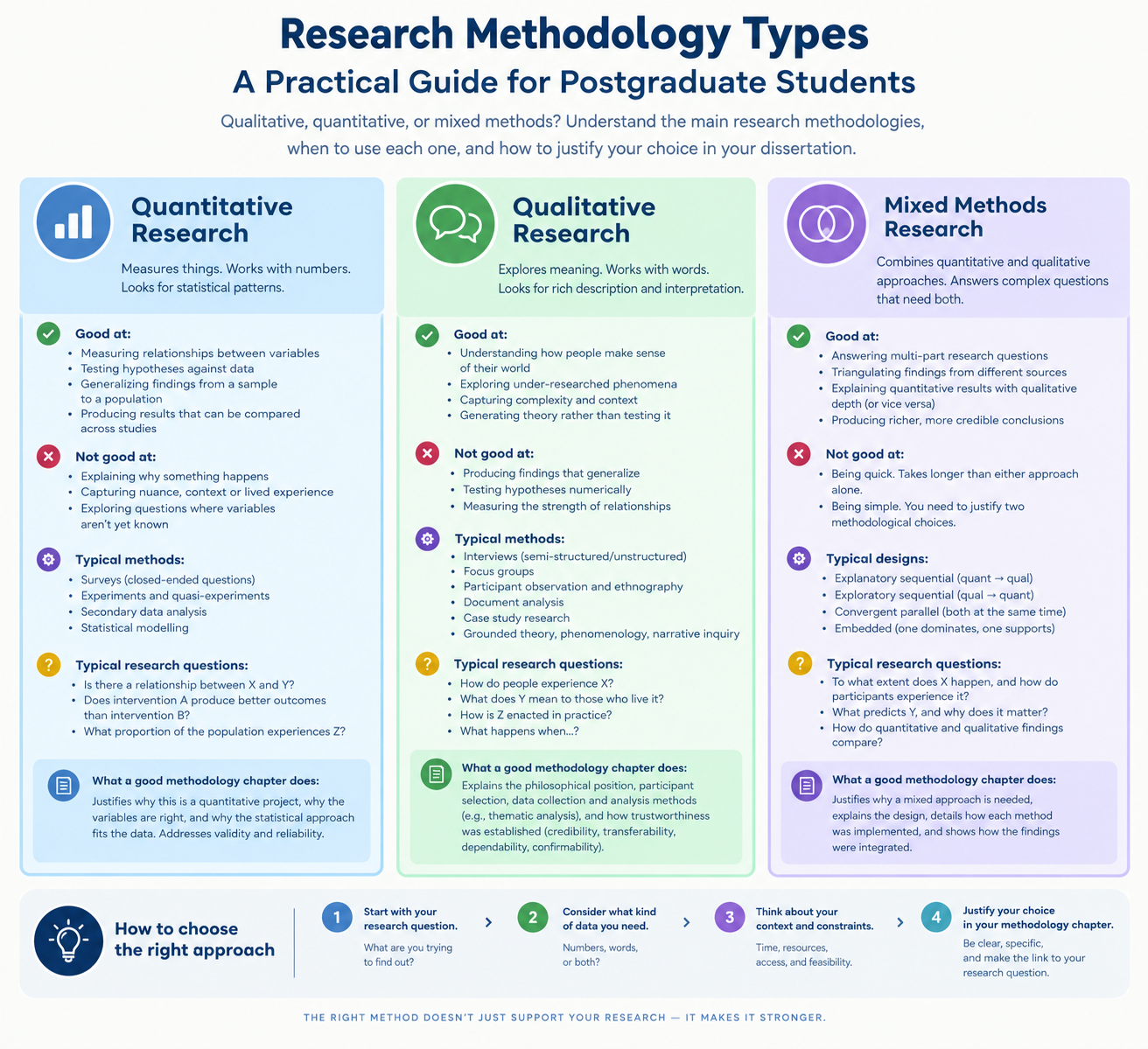
The Summary
Pick the method that answers your question — not the one that seems easiest, or the one your supervisor likes.
If it's quantitative, justify why. If it's qualitative, justify why. If it's mixed, justify why both.
And whatever you choose, be honest about its limits. Every method has them. Acknowledging them is a strength, not a weakness.