The literature review is where most students either lose their way or find it.
If you write it well, it becomes the intellectual backbone of your entire dissertation. Every subsequent chapter will refer back to it. Every methodological choice will be justified by something you established there. Every finding will be framed as a contribution to a debate you set up in the review.
If you write it poorly, nothing else works quite right. The methodology chapter feels unmoored. The findings feel disconnected. The conclusions feel unearned.
This guide walks through how to write one that works — from the first search to the final paragraph. It's not a checklist. It's a way of thinking about the task that will shape every decision you make.
What a literature review actually is
Let's clear up the biggest misconception first.
A literature review is not a summary of what other people have written.
It's a critical synthesis — a structured argument about the current state of knowledge in your field. It shows the reader:
- What is already known
- What is contested or unclear
- What has not yet been studied (the gap your research fills)
Summaries say "Author A said X. Author B said Y. Author C said Z."
Syntheses say "There is broad agreement that X, but Author B and Author C disagree about its implications for Y — and no study has examined this in the context of Z."
The first reads like a reading list. The second reads like a researcher thinking.
Examiners are looking for the second.
Before you write anything
The quality of a literature review is determined mostly by what happens before you write it. If you skip these three steps, you'll end up with a pile of notes you don't know what to do with.
Step 1 — Define your scope
You can't review "all the literature on education." You have to narrow it.
Decide in advance:
- Time period: the last 10 years? 20? All time, but weighted toward recent?
- Disciplines: just your own? Or adjacent fields?
- Geographic focus: global? Regional? National?
- Types of sources: peer-reviewed only? Including grey literature? Policy documents?
Write down your criteria. You'll come back to them throughout the process, and having them documented makes your methodology chapter stronger.
Step 2 — Do a systematic search
Don't just search Google Scholar with one phrase. Use a real search strategy.
Start with a search matrix. In one column, list your key concepts. In the other, list synonyms for each.
For example, if you're researching teacher burnout:
| Concept 1 | Concept 2 | Concept 3 |
|---|---|---|
| teacher | burnout | secondary school |
| educator | exhaustion | high school |
| faculty | stress | adolescent education |
| instructor | attrition | K-12 |
Combine them with AND/OR. (teacher OR educator OR faculty) AND (burnout OR exhaustion OR stress).
Search at least three databases relevant to your field. For social sciences, that's likely to be:
- Web of Science
- Scopus
- ERIC or PsycINFO
- Google Scholar (as a supplement, not a primary)
Use snowballing. When you find one really good source, look at:
- Who they cited (backward snowball)
- Who cited them (forward snowball)
This finds literature that keyword searches miss.
Keep a search log. Every combination you try, every database, every filter. You'll want this for your methodology chapter — it demonstrates rigour.
Step 3 — Screen ruthlessly
You'll find hundreds of results. You'll read dozens. You'll cite maybe 40–80. The gap between those numbers is where the work happens.
Title screening: based on the title alone, is this potentially relevant? Discard anything obviously off-topic.
Abstract screening: read the abstract. Does this address your question? Is the methodology sound? Is it peer-reviewed?
Full-text screening: read the paper. Does it actually contribute to your argument?
Take notes as you go. For each source you keep, record:
- Full citation
- Key argument
- Methodology (brief)
- Main findings
- Limitations
- How it connects to your research question
This note-taking step is what separates students who end up with a strong review from those who end up with a pile of photocopies.
The structure — how to organize
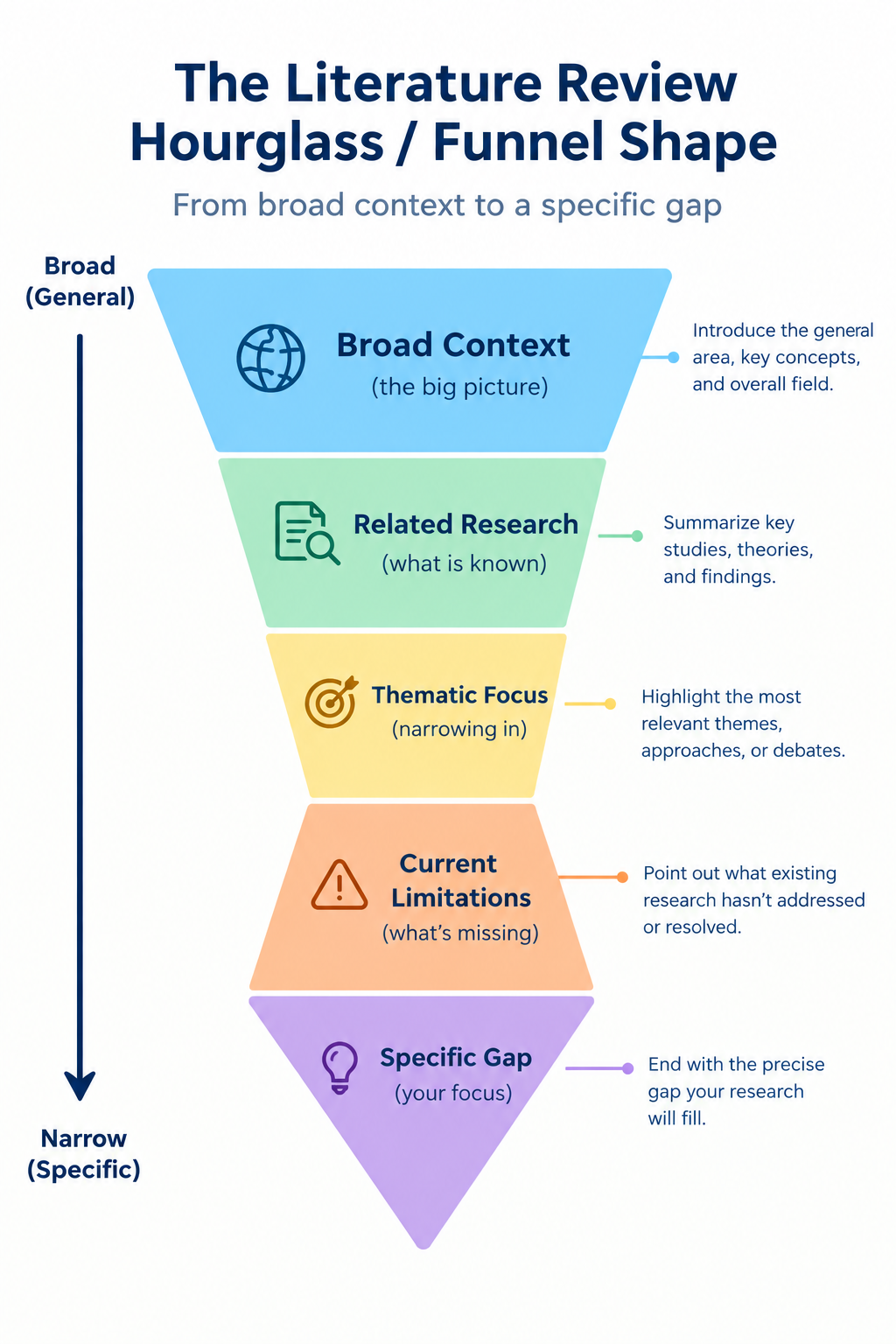
There is no single correct structure, but the strongest literature reviews follow a similar shape. Think of it as an hourglass.
The funnel: broad to narrow
Start with the broad context of your field.
Then narrow to your specific area.
Then narrow further to your specific question.
Then land on the gap.
For example:
[Broad] The relationship between teacher wellbeing and student outcomes has been studied extensively over the past two decades.
[Narrowing] Most of this work has focused on primary school settings, where the effects are well documented.
[Narrower] Secondary school contexts have received comparatively less attention, despite evidence that adolescent learners are particularly sensitive to teacher morale.
[Gap] However, no study to date has examined how burnout affects teacher-student relationships specifically in the transition years between primary and secondary education — which is where this dissertation focuses.
Notice the shape: each paragraph takes the reader one step closer to your specific contribution.
Thematic vs chronological
Within that funnel structure, you have two main ways to organize your sources.
Thematic organization groups sources by theme, argument, or approach. This is usually better — it lets you show the state of debate rather than just the timeline.
Example themes for a burnout review:
- Theme 1: Causes of burnout (workload, admin burden, lack of support)
- Theme 2: Consequences for teachers (health, attrition, satisfaction)
- Theme 3: Consequences for students (classroom climate, engagement, outcomes)
- Theme 4: Interventions (what works, what doesn't)
Within each theme, you synthesize and critique. You show what's agreed, what's debated, and what's missing.
Chronological organization walks through the history of research on your topic. It's useful when the field has clearly evolved — e.g., a methodology that's been replaced, or a debate that's shifted.
But even within chronological structure, organize by theme within each period. Pure chronology reads like a history lesson, not a research review.
Synthesis paragraphs, not source-by-source
The single biggest mistake in literature reviews is the "one paragraph per source" pattern.
Bad:
Smith (2018) found that teacher burnout was associated with higher administrative workload. Jones (2019) found similar results in a sample of 300 secondary teachers. Patel (2020) argued that burnout is primarily driven by student behaviour. Lee (2021) found that school culture played a mediating role.
This reads like a book report. Each sentence names a source and states what it found. There's no analysis.
Better:
There is broad agreement that administrative workload is a significant contributor to teacher burnout (Smith, 2018; Jones, 2019). However, the field is divided on the role of student behaviour — Patel (2020) argues it's the primary driver, while Lee (2021) positions it as a symptom of poor institutional culture rather than a cause. This disagreement is significant because it determines whether interventions should target individual classrooms or whole-school systems.
Same sources. Completely different effect. The second paragraph tells the reader what's contested and why it matters.
Rule of thumb: if a paragraph cites only one source, it's probably a summary. If it cites three or more and compares them, it's a synthesis.
Writing the introduction to your review
Before the main body, write a short introduction that does three things:
- Establishes the topic — one or two sentences on what your review covers.
- Explains the scope — what's included and what's excluded, briefly.
- Signposts the structure — how the review is organized.
Example:
This review examines the literature on teacher burnout in secondary education, with a focus on studies published between 2010 and 2024. It covers the causes of burnout, its consequences for teachers and students, and evaluated interventions. The review is organised thematically, beginning with a discussion of what burnout is, then examining its antecedents, followed by its effects, and finally the evidence base for intervention. Studies from primary education are included where they offer theoretical insight, but the primary focus is on secondary contexts.
Short. Clear. Three paragraphs maximum.
Finding the gap
The literature review must end with an identified gap — the space your study fills.
A gap isn't just "nobody has studied this exact thing." That's not enough — nobody has studied most things in exact detail.
A real gap is one of these:
- A population gap: existing research focuses on Group A, but Group B might behave differently.
- A context gap: studies have been done in Country A, but not in Country B.
- A methodological gap: previous studies used method X, but method Y might reveal something new.
- A theoretical gap: existing theory predicts X, but nobody has tested it in situation Y.
- A synthesis gap: two areas of research have been conducted separately, but nobody has brought them together.
Here's how to phrase a gap:
While the effects of teacher burnout on classroom climate have been well documented (Author, Year; Author, Year), most studies have relied on cross-sectional data, which cannot establish causal direction. Longitudinal work is needed to determine whether burnout precedes poor climate, or whether poor climate accelerates burnout. Additionally, no study to date has focused specifically on the transition years, where students and teachers often remain together for multiple subjects.
Notice: (1) acknowledges what's known, (2) names the specific limitations of existing work, (3) explains why the gap matters, and (4) makes the case for your study.
That last point is the one that often goes missing. It's not enough to say "no one has studied X." You must explain why studying X matters.
A worked example
Here's a short excerpt from what a strong literature review section looks like in practice. This is a fictional review on teacher burnout, but the structure and language are what you should aim for.
The consequences of burnout for classroom practice
Research on the consequences of teacher burnout has consistently identified effects on classroom climate and instructional quality. Teachers reporting high emotional exhaustion tend to exhibit lower warmth and higher reactivity in their interactions with students (Jennings & Greenberg, 2009; Oberle & Schonert-Reichl, 2016), and students in these classrooms show lower academic engagement and higher behavioural problems (Klusmann et al., 2016). This is important because it suggests burnout is not just a teacher-level concern, but a systemic one with measurable effects on student outcomes.
However, the field has struggled to establish causal direction. Cross-sectional studies cannot determine whether burnout causes poor classroom climate, whether poor climate accelerates burnout, or whether both are driven by a common third factor such as inadequate school resources. The few longitudinal studies that exist (Hakanen et al., 2006) offer preliminary evidence for a reciprocal relationship, but they were conducted in Finnish primary schools — a context significantly different from most secondary systems in terms of both teacher workload and student-teacher ratios.
What is missing, then, is longitudinal research in secondary school contexts — particularly in systems where teachers and students interact across multiple subjects and years. This is precisely the setting in which the reciprocal effects of burnout and climate are most likely to compound, yet it is also the setting in which the least research has been done.
Notice the pattern:
- Synthesis — multiple sources woven into an argument, not listed
- Evaluation — acknowledges strengths and weaknesses of existing work
- Progression — each paragraph moves the argument forward
- Gap — clearly identified and justified
- Bridge — ends by explaining why the gap matters for the current study
That's what a literature review is supposed to do.
Common mistakes — and how to avoid them
Mistake 1: Summarizing instead of synthesizing. Fix: never let a paragraph cite only one source. If it does, find a way to bring in another perspective or contrast.
Mistake 2: Overusing quotes. Direct quotes have their place — when an author has said something so precisely that paraphrasing would lose meaning. But 90% of your review should be in your own words. If you're quoting more than a couple of sentences per page, you're using them as a crutch.
Mistake 3: Missing the disagreement. A good review shows where scholars disagree, not just where they agree. If everything you've found says the same thing, either you haven't looked hard enough, or your scope is too narrow.
Mistake 4: No connection to your own study. The review isn't a stand-alone essay on your topic. Every section should subtly move toward your research question. If a paragraph doesn't contribute to that movement, cut it.
Mistake 5: Skipping the classics. Yes, research should be current. But there are foundational studies in every field — papers that defined the terms of debate — and you must engage with them regardless of date. A review of literature on growth mindset that doesn't mention Dweck is signalling that the author hasn't done the reading.
Mistake 6: The shopping list. You don't need to cite every source you found. A review with 40 well-chosen sources read closely is better than one with 150 skimmed. Dense citation lists don't impress examiners — they reveal a lack of judgement about what matters.
Mistake 7: Burying the gap. Your identified gap should be unmistakable. It should get its own paragraph. If it's embedded in a sentence in the middle of a longer section, you've buried the most important thing in the chapter.
Before you consider it done
Run this check on the final draft:
- Does the review have a clear introduction that establishes scope and structure?
- Does it progress from broad context to your specific question?
- Does every paragraph synthesize multiple sources rather than summarizing one?
- Does it acknowledge where scholars disagree — not just where they agree?
- Are foundational texts engaged, even if they're old?
- Is the gap to your study clearly identified and justified?
- Does the gap paragraph explain why filling that gap matters?
- Is the citation style consistent throughout?
- Have you used quotes sparingly?
- Does the review read as an argument, not a summary?
If all ten are true, you've written something that will hold up under examination.
When to get help
If you're stuck on your literature review — or if you've written a draft and something about it feels off but you can't name what — it might be that you're still at the "summary" stage rather than the "synthesis" stage. This is by far the most common issue, and it's often invisible to the writer.
Our writers and editors work with students across disciplines on literature reviews at every stage. We can help with:
- Searching and selecting sources if you're struggling to find the right literature
- Structuring your review if you have the material but not the shape
- Rewriting if you've produced a summary and need to convert it into critical synthesis
- A full review written from scratch if you'd rather work with a specialist in your field
If you'd like help, create a free account and describe what you're working on. No pressure, no obligation.
For related reading, see our guide on research methodology types and our methodology chapter guide.
For related reading, see our guide on research methodology types, our methodology chapter guide, and our guide on how to write a dissertation conclusion.
Further reading
- Booth, A., Sutton, A., & Papaioannou, D. (2016). Systematic Approaches to a Successful Literature Review. SAGE.
- Hart, C. (2018). Doing a Literature Review: Releasing the Research Imagination. SAGE.
- Ridley, D. (2012). The Literature Review: A Step-by-Step Guide for Students. SAGE.
- Webster, J., & Watson, R. T. (2002). Analyzing the past to prepare for the future: Writing a literature review. MIS Quarterly, 26(2), xiii–xxiii.
- Xiao, Y., & Watson, M. (2019). Guidance on conducting a systematic literature review. Journal of Planning Education and Research, 39(1), 93–112.
The short version
A literature review is not a summary. It's an argument about what's known and what isn't, told through the sources you've chosen.
Search systematically. Read closely. Take real notes. Organize thematically. Synthesize — don't list. And end with a gap that makes your own study inevitable.
Do that, and the rest of your dissertation will be easier to write. Because your review will have done the work of justifying why every following chapter needs to exist.